No aural survey of American vernacular music would be complete without St. Louis Blues. Penned by W.C. Handy in 1914, no popular song has been recorded more! The version in this listening journal is performed by Bessie Smith and Louis Armstrong.
St. Louis Blues is relatively complex in comparison to other popular songs. The overall form, AABA with the return A being more of a C, is similar to other Tin Pan alley songs we've heard so far. Handy melded the blues with Tin Pan alley writing to create St. Louis Blues. The A sections are in a twelve bar blues form (a form hugely influential in American vernacular music). The B section is in a contrasting minor key and is the best known part of the song. The lyrics of the A section are more general while the B section paints a picture of the "St. Louis Woman." The B section also contains elements of Latin music like the habanera to create an "exotic" feel.
Bessie Smith's recording is faithful to the original in many ways, but she takes some freedoms with more blue notes and stretched lyrical moments. Louis Armstrong's call-and-response melodies occur throughout the song and seem to be commenting on Bessie's lyrics. Besides vocals and trumpet, accompaniment is provided by a reed organ. It is interesting to hear organ rather than piano, but it does help to reinforce the mood of the song.
While St. Louis Blues presents a more formal blues style, country blues recordings are more indicative of the roots of blues music found in the Mississippi Delta. Blind Lemon Jefferson was the first recorded country blues artist. From Texas, Jefferson's style still reflects the Mississippi roots of the blues. That Black Snake Moan uses the AAB lyric form of the blues, but the musical background from the guitar is more riff based rather than clear twelve bar blues. Jefferson stretches the tempo at will and creates moments of tension with loudly sung blue notes.
The lyrics of That Black Snake Moan are very different from narrative, Anglo ballads (there is no clear order to the lyrics). The words seem to address a specific person and then the audience at various points. The sexual nature of the lyrics is typical of blues text. Blind Lemon Jefferson's song may have had some appeal for this very reason as most songs of the time were of idyllic times and places.
Swing
The rise of swing music can largely be credited to Fletcher Henderson as far as inspiration is concerned. Before Henderson, the syncopated dance bands of the 20s were smaller and used arrangements more suited to upright, ballroom dancing. Henderson's band was larger (using the now traditional big band numbers found in high schools across the country) and had a far different style that can be heard in songs like Wrappin' It Up.
The larger size of Henderson's band allowed him to write songs that included more call-and-response elements. The various sections can be heard having a musical "conversation" throughout. The very beginning includes a saxophone melody with brass "hits" in response. The swing style is also different from the dixieland style with less polyphonic textures. Wrappin' It Up also includes a number of improvised solos common in jazz and are the hallmark of great jazz bands. The swing style of Henderson's song is also found in a more flowing beat rather than the 1 and 3 emphasis of syncopated dance music. The bass "walks" while the drummer has a ride cymbal pattern. This smoother style was better suited to swing dancing.
The form of the song is ABAC repeated four times. Each repetition is fresh since they are varied in texture; sometimes a section is a solo while other times the same section is call-and-response. Wrappin It Up is a prime example of swing era music. Of course that is no accident, Henderson wrote arrangements that Benny Goodman's band performed. Goodman would go on to spark the swing craze while playing Henderson's charts.
One example of a Fletcher Henderson arrangement played by Goodman's big band is Taking a Chance on Love. Originally a Tin Pan Alley song by Vernon Duke. Henderson arranged the song which became a Billboard number one. Once again, Henderson uses call-and-response- techniques between the sections. He also includes harmonized melody and soli sections.
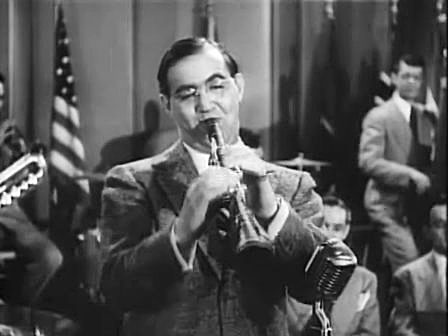
The vocal section, sung by Helen Forrest, is the familiar AABA (32 bar) form of Tin Pan Alley songs. Helen, a female crooner, sings the song sweetly and clearly. Big band era singers were not the headline names seen in today's music. Instead, the band leader received top billing. The vocal section is preceded and followed by statements of the melody by the band. The opening sections are odd numbers of measures, but Henderson makes it sound completely natural. Overall, the song is heard three times creating a larger ABA form with the middle section being a vocal rendering of the melody.
Of the swing era recordings, the most popular, and the best know today, is Glen Miller's In The Mood. The opening riff is instantly recognizable, and , though Miller didn't write it, helps to set the "mood" for this song. The building block of this piece is the twelve bar blues which alternates with an 8 bar bridge phrase. Like the songs heard above, In The Mood has all the important elements of a swing era song. Call-and-response, solos, and walking bass are all evident. The song has a striking simplicity using an easy, syncopated sax melody for the twelve bar blues sections.
Like many jazz critics, I've been highly critical of the simplicity of In The Mood. However, a closer listening reveals a well written song. An "ear worm" like this must contain simple elements that are catchy and memorable. Despite the easy melody built around three chords, the ending helps to make this song very innovative. The repeated melody gets ever quieter and the trombone drone helps to elongate phrases. After the quietest repetition, the song ends with a loud tag. This surprise ending may not be surprising in a second hearing, but Americans at the time needed an escape from the reality of war. Music, in many ways, still acts as an escape for many people.
I'm only going to take a moment to note my favorite composer of the swing era. Though he didn't enjoy as much success as the white bandleaders of the time, Duke Ellington was ultra-prolific and wrote music of outstanding complexity and artistry. From his suites (like his treatment of Peer Gynt) to his "jungle music", Ellington has music that really stands the test of time and shows jazz as an art form. His best known song, "Take the A-Train," showcases the same elements of the swing era as the other songs noted above, but has a certain vibrancy and energy. The song was written by Billy Strayhorn, a long time collaborator with Duke, and has an AABA form (yes, Tin Pan Alley). The two sections are contrasting in key. The solo occurs over the chords of the entire form much like a jazz combo. The trumpet solo in the original song was written out and embellished, bu this solo is elongated and improvised (by my band director from high school's son Ryan Kisor no less!).
In addition to the ubiquity of big bands in the swing era, harmony groups like the Andrew's Sisters, Ink Spots, and Mills Brothers were popular. Harmony groups had been around for quite some time and often sang popular times including Stephen Foster songs. The harmony group concept still continues today and it's influence can be seen in the music of Motown and others. The Mills Brothers had a hit in Paper Doll.
The song is a polished rendition of an old Tin Pan Alley song by Johnny S. Black. The lyrics are quite old-fashioned and tell of a young man who would rather deal with a paper version of girls than the real thing. The song begins with a solo voice and guitar accompaniment supported by rich harmonies in a slow tempo. After this first statement of the melody, the song continues in double time. The Mills Brothers go from solo voice to close harmonies (reminiscent of a big band sax soli) to unison voice with precision. The Mills Brother's rendition of Paper Doll showcases their high level of vocal skill and uses a lighter treatment of the song to avoid too much sentimentality. They used this technique of starting lyrically then adding a double time feel in more than just this song. Using a musical concept over and over is not only used by the Mills Brothers, other groups like the Ink Spots (who used a spoken treatment of the lyrics by their bass singer in many of their songs) used common formal arrangements of their songs multiple times. This likely helped the listener find familiarity from one song to another. We can see many artists re-using material from hits to make more songs. In fact, fans often become angry when the sound of their favorite artists change. From Bob Dylan to Miley Cyrus, popular music fans like their music to stay the same and their artists to be predictable. A quote from John Lennon in the Anthology gives an inside look at how artists might feel about this:
"The Help! single sold much better than the two before it: I Feel Fine and Ticket To Ride. But there were still a lot of fans who didn't like Help!. They said, 'Ah, The Beatles are dropping us. This isn't as good as A Hard Day's Night.' So you can't win. Trying to please everybody is impossible - if you did that, you'd end up in the middle with nobody liking you. You've just got to make the decision about what you think is your best, and do it.
People think of us as machines. They pay 6s 8d for a record and we have to do what they say - like a jack-in-the-box. I don't like that side of it much. Some people have got it all wrong. We produce something, something great every time. The onus is on the public to decide whether they like it or not. It's annoying when people turn round and say, 'But we made you, you ungrateful swines.' I know they did, in a way, but there's a limit to what we're bound to live up to, as if it's a duty."
from http://www.beatlesbible.com/songs/help/

No comments:
Post a Comment